
If your dishwasher has started leaving gritty bits on glasses, a film on plates, or a smell that hits you when you open the door, the culprit is very often a part most people don’t know exists: the filter.
Older dishwashers commonly used a self-cleaning system with a small grinder (sometimes called a hard-food disposer) that chopped up food scraps and sent them down the drain. Many newer models — especially quieter, more energy-efficient ones — switched to a manual filter instead. It does a better job of keeping the wash water clean and the machine quieter, but there’s a catch: it doesn’t clean itself. You’re supposed to do it.
Signs your dishwasher filter is clogged
- Small food particles stuck to dishes and glasses after a cycle
- A gritty or sandy feel on cups
- Cloudy film that wasn’t there before
- Standing water in the bottom of the tub after a cycle
- A sour, musty or “old food” smell
- Dishes coming out noticeably less clean even with good detergent
When the filter is packed with debris, the pump recirculates dirty water and the spray arms can’t push enough clean water onto your dishes. It’s like washing your car with a bucket of muddy water.
How often should you clean it?
Manufacturer recommendations vary, but a common guideline is about once a month, and more often if you run the machine daily or don’t scrape plates well. If you run it only a few times a week, every two to three months may be enough. Your owner’s manual will have the exact interval for your model.
Where to find it
Pull out the bottom rack. On the floor of the tub, usually near the back or center and beneath the lower spray arm, you’ll see a round or cylindrical part, often with a grip or arrows on top. That’s the filter assembly. Many have two pieces: a cylindrical fine filter that twists out, and a flat coarse mesh screen underneath it.
If you can’t find it, search your model number plus “filter” — most manufacturers publish diagrams or short videos.
Step-by-step: cleaning the filter
- Turn the dishwasher off. Make sure it isn’t mid-cycle and the water has cooled.
- Remove the bottom rack to give yourself room.
- Twist and lift out the cylindrical filter. Most turn counterclockwise a quarter turn, then lift straight up.
- Lift out the flat mesh filter beneath it, if your model has one.
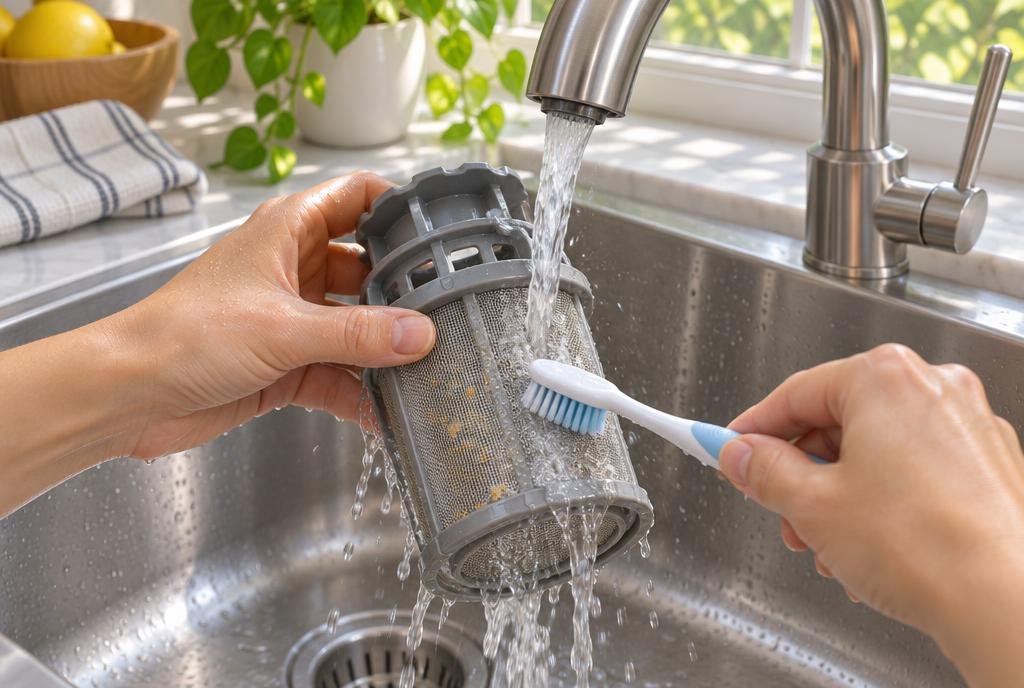
- Rinse under warm running water to knock off loose debris.
- Scrub gently with a soft brush — an old toothbrush or soft dish brush — and a few drops of dish soap. Pay attention to greasy film, which traps more debris. Avoid wire brushes or scouring pads, which can tear the fine mesh.
- Check the sump area where the filter sits. Wipe out any glass shards, seeds, labels or bits of food with a damp paper towel. Be careful — broken glass often hides here.
- Reinstall the flat filter first, then twist the cylindrical filter back until it locks. A loose filter lets debris bypass it and can damage the pump.
That’s it. The whole job usually takes about five minutes, and the difference on your next load can be dramatic.
Don’t forget the spray arms
While you’re in there, look at the spray arms — the spinning bars at the bottom (and usually one under the top rack). Their small holes can clog with food bits or mineral scale, which leaves certain spots of the racks poorly cleaned.
- Spin each arm by hand. It should move freely.
- Many arms pop or unscrew off. Check your manual.
- Rinse them and clear blocked holes with a toothpick. Avoid anything that could break off inside.
- If the holes are crusted with white scale, soak the arm in white vinegar for an hour, then rinse well.
Five habits that make your dishwasher work better
1. Scrape, don’t pre-rinse
This surprises many people. Modern dishwasher detergents contain enzymes designed to break down food soils. Detergent makers commonly advise scraping off big chunks but skipping the full rinse — enzymes need something to work on, and pre-rinsing wastes a lot of water.
2. Run the kitchen tap hot first
Before starting a cycle, run the kitchen faucet until the water is hot. Your dishwasher draws from the same hot water line, so this means the first fill is hot instead of lukewarm, which helps detergent dissolve and work.
3. Use rinse aid
Rinse aid lowers water’s surface tension so it sheets off dishes instead of forming droplets. That means fewer spots and much better drying, especially on plastics. If your dishes come out wet, rinse aid is often the fix — not a broken heater.
4. Load so water can reach everything
Face dirty surfaces toward the center or the spray arm. Don’t let tall items block the top arm, and don’t nest bowls. Cutlery mixed handle-up and handle-down avoids spoons spooning each other.
5. Clean the door gasket and edges
The rubber seal around the door and the bottom edge of the door don’t get sprayed directly, so gunk builds up there. Wipe them monthly with a damp cloth and a little dish soap.
When a clean filter doesn’t fix it
If you’ve cleaned the filter and spray arms and still have problems, a few other things are worth checking:
- Hard water: a white, chalky film that wipes off with vinegar suggests mineral deposits. A dishwasher cleaner product, rinse aid, and a detergent formulated for hard water can help. Some machines have a built-in water softener with a salt reservoir.
- Drain hose problems: standing water after a cycle can mean a kinked drain hose, a clogged garbage disposal (if the dishwasher drains through it), or — after installing a new disposal — a knockout plug that was never removed.
- Old detergent: powder that’s absorbed humidity clumps and won’t dissolve. Store detergent in a cool, dry place.
- Too much detergent: more isn’t better. Excess detergent can leave a film, especially in soft water.
If none of that helps, problems like a failing wash pump or heating element are jobs for an appliance technician.
Quick monthly dishwasher checklist
- Clean the filter
- Check spray arms spin freely and holes are clear
- Wipe the door gasket and door edge
- Top up rinse aid
- Run a cleaning cycle with a dishwasher cleaner if your manual recommends it
Frequently asked questions
Does my dishwasher have a filter?
Most dishwashers do. Some older or certain models use a self-cleaning system with a grinder instead. If you see a removable cylinder at the bottom of the tub, you have a manual filter.
Can I put the filter in the dishwasher to clean it?
No — it needs to be installed for the machine to run properly. Hand-wash it in the sink.
Is it safe to run the dishwasher without the filter?
No. Debris can reach the pump and damage it. Always reinstall the filter before running a cycle.
